The modern academic landscape is often described as a whirlwind of shifting deadlines, complex theories, and the constant pressure to perform. For many students, the weight of a mounting to-do list leads to a paralyzed state of procrastination. We’ve all been there: staring at a blank document while the clock ticks toward midnight, feeling the physical tightening of stress in our chests. However, the secret to breaking this cycle isn’t found in a sudden burst of “willpower” or pulling a series of caffeine-fueled all-nighters. Instead, it lies in the subtle, scientific art of habit stacking—a method that rewires how we approach productivity by building on the foundations we already have in place.
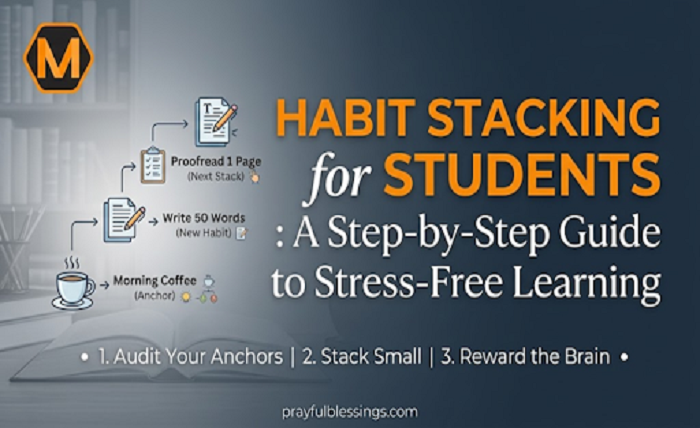
Most students fail to maintain new study habits because they try to build them out of thin air. Habit stacking, a term popularized by James Clear in Atomic Habits, suggests that you “stack” a new behavior onto a current one. By identifying a routine you already perform each day and placing your new academic goal right on top of it, you create a natural neurological trigger. For instance, if you always pour a cup of coffee at 8:00 AM, that coffee becomes the “cue” to open your research folder. During those particularly heavy semesters where the workload feels insurmountable, integrating professional assignment assistance through platforms like myassignmenthelp can serve as a vital part of your academic stack, ensuring that the transition from a morning ritual to a productive study session is seamless and supported.
The Science of the “Trigger-Action” Loop
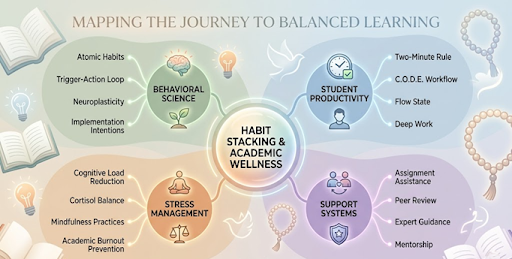
At its core, habit stacking is a practical application of “implementation intentions.” Your brain is essentially a giant machine for making connections. Every time you perform an action, your neurons fire in a specific sequence. When you perform that action repeatedly—like brushing your teeth, making your bed, or checking your phone—that neural pathway becomes a paved highway. Habit stacking hitches a ride on these established highways. Instead of trying to carve a new path through a dense jungle of mental resistance, you simply add a small detour to a road you already travel every day.
This process significantly reduces what psychologists call “cognitive load.” When we have to decide when, where, and how to study, we use up precious mental energy before we even begin the actual work. By creating a specific formula—“After [Current Habit], I will [New Habit]”—the decision-making process is eliminated. This leads to a state of “flow” where the brain moves into a productive mode with minimal friction. For students tackling highly technical subjects, this structural clarity is essential. For example, if you are a STEM major, you might say, “After I close my laptop from my morning lecture, I will review one complex problem for my engineering assignment help to ensure I’m keeping pace with the curriculum.”
1. Identifying Your “Anchor” Habits
The first step in building a stress-free learning system is to audit your day for “anchors.” These are the non-negotiable actions you perform without thinking. Common anchors include:
- Morning Anchors: Waking up, stretching, making coffee, or brushing teeth.
- Transition Anchors: Getting in the car, boarding a bus, or arriving at a library.
- Maintenance Anchors: Charging your phone, closing your laptop, or washing dishes.
- Evening Anchors: Changing into pajamas, setting an alarm, or reading a book.
Once you have a list of these anchors, you can begin to see where your “study stacks” can fit. The key is to match the energy level of the anchor with the energy required for the new task. You wouldn’t want to stack “write a 2,000-word essay” onto “waiting for the kettle to boil,” because the timeframes don’t match. Instead, stack “organizing my references” or “checking my syllabus” onto that short window of time.
2. The Habit Stacking Framework (A Comparative Table)
To visualize how habit stacking compares to traditional goal-setting, look at the table below. Notice how the “Stacked” version removes the ambiguity that often leads to stress.
| Traditional Goal | Habit Stacked Equivalent | Why It Works |
| “I will study more this week.” | “After I finish my lunch, I will read 5 pages of my textbook.” | Uses a physical cue (lunch) to trigger action. |
| “I need to start my dissertation.” | “After I sit at my desk, I will write 50 words for my intro.” | Reduces the “Two-Minute” barrier to entry. |
| “I’ll review notes later.” | “After I close my laptop for class, I will summarize 3 key points.” | Captures information while it’s fresh in short-term memory. |
| “I will be more organized.” | “After I plug in my phone at night, I will write my top 3 tasks for tomorrow.” | Uses a final daily anchor to clear mental clutter. |
3. The “Two-Minute Rule” for Massive Success
A common mistake in student productivity is over-ambition. We tell ourselves we will study for four hours straight after dinner. Usually, by the time dinner is over, the brain is too tired to start such a massive task. Habit stacking works best when the initial “stack” is incredibly small—so small it feels impossible to fail.
If you want to build a habit of better research, your stack should be: “After I sit down at my desk with my water bottle, I will find two peer-reviewed sources.” That’s it. Often, once you start those two minutes of work, the “Zeigarnik Effect” kicks in—a psychological phenomenon where our brains want to finish a task once it has been started. The hardest part of learning is the initiation; habit stacking is the ultimate tool for overcoming that initial inertia.
4. Designing Your Academic Ecosystem
To truly reduce stress, your environment must support your habits. This is known as “choice architecture.” If your phone is sitting next to your textbook, your brain will subconsciously battle the urge to check notifications, wasting energy on “willpower” that should be used for learning. A successful stack includes environmental cues.
The Flowchart of Focus:
- Visual Cue: See your textbook on the desk (Trigger).
- Physical Action: Put phone in the other room (Boundary).
- The Stack: Sit down and open the book (Habit).
- The Reward: 5 minutes of stretching after 25 minutes of work (Reinforcement).
By physically separating your “distraction zone” from your “focus zone,” you strengthen the trigger-action loop. Over time, your brain begins to associate your desk exclusively with a specific state of mind. This is how top-performing students seem to study “less” than their peers while achieving higher marks; they aren’t working harder, they are working with the grain of their brain’s natural biology.
5. Overcoming the “Cognitive Burnout” Wall
There will be weeks where even the best habits feel heavy. Midterms, finals, and major projects can lead to cortisol spikes that interfere with memory retention. This is where the concept of “strategic delegation” enters the habit stack. Stress-free learning isn’t about doing everything yourself; it’s about managing your resources effectively.
When the technical requirements of a project exceed your current bandwidth—perhaps during a grueling semester of thermodynamics, structural analysis, or organic chemistry—recognizing when to seek specialized guidance is a skill in itself. Integrating a check-in with a mentor or utilizing specific tools for complex problem-solving can be the difference between a breakdown and a breakthrough. Once the heavy lifting of the initial research is supported, you can return to your routine with a cleared mind and a focused intent.
6. The Neurobiology of Rewards
The final piece of the habit-stacking puzzle is the reward. Our brains are driven by dopamine loops. If you finish a study session and immediately feel guilty that you didn’t do more, you are essentially “punishing” your brain for studying. This makes it harder to repeat the habit tomorrow.
Instead, create a small, immediate reward for completing your stack. It could be five minutes of your favorite music, a quick walk outside, or simply the satisfaction of crossing an item off a physical list. This small hit of dopamine reinforces the neural pathway, making the “trigger” even stronger the next time it occurs.
7. A 30-Day Implementation Roadmap
To move from theory to practice, follow this structured plan to integrate habit stacking into your life:
- Week 1: The Audit. Identify 5 solid anchors in your day and 5 tiny academic habits you want to start.
- Week 2: The Pairing. Create your “After [Anchor], I will [Habit]” formulas. Stick to the 2-minute rule.
- Week 3: Environment Design. Adjust your study space to remove friction. Ensure your books are open and your distractions are hidden.
- Week 4: The Evaluation. Review your progress. If a stack isn’t working, don’t blame yourself—simply change the anchor.
8. Dealing with Perfectionism
Many students stop their habits the moment they miss a day. This “all-or-nothing” thinking is the enemy of progress. In the world of habit stacking, the goal is not perfection, but “non-negotiable presence.” If you are too sick to study for an hour, your stack should simply be: “After I take my medicine, I will read one paragraph.” By doing the bare minimum, you keep the neural pathway alive, making it much easier to return to full strength the following day.
Conclusion: The Long Game of Learning
Habit stacking is not a “magic pill” that will result in a perfect GPA overnight. It is a long-term strategy designed to turn the mountain of academic stress into a series of manageable, daily steps. By respecting your brain’s limits and leveraging its natural patterns, you move away from the “panic-and-crash” cycle and toward a sustainable, peaceful way of living.
Success in the academic world is rarely about being the smartest person in the room; it is almost always about being the person with the most consistent systems. When you stop relying on fickle motivation and start relying on the power of the stack, the “stress-free” part of learning becomes your new reality. Start today with one small anchor and one tiny stack. You’ll be surprised at how quickly those small steps lead to a massive change in your perspective—and your results.
Frequently Asked Questions
What exactly is habit stacking?
It is a behavioral science technique where you pair a new, desired habit with an existing, automatic routine. By using an established neural pathway as a “trigger,” you reduce the mental effort required to start a new task, making it much easier to stay consistent with your goals.
How long does it take for a new “stack” to feel automatic?
While common myths suggest it takes 21 days, research in neurobiology suggests it can take anywhere from 18 to 254 days depending on the complexity of the task. The key is to keep the initial action so small that you can perform it even on your most stressful days.
Can I stack multiple habits together at once?
Yes, this is known as a “habit chain.” However, it is best to master one single pairing for at least two weeks before adding a third or fourth task. Overloading your brain with too many new requirements at once can lead to cognitive burnout and habit failure.
What should I do if I miss a day in my routine?
Follow the “never miss twice” rule. Missing one day has a negligible impact on your long-term progress, but missing two days in a row can start to form a new habit of “not doing” the task. Simply return to your anchor the next day without guilt.
About The Author
Min Seow is a dedicated digital strategist and education consultant who specializes in modern productivity frameworks. With a focus on helping students navigate the complexities of higher education, Min advocates for sustainable learning habits and academic wellness. As a lead contributor for MyAssignmentHelp, they bridge the gap between traditional study methods and innovative success strategies for a global audience.