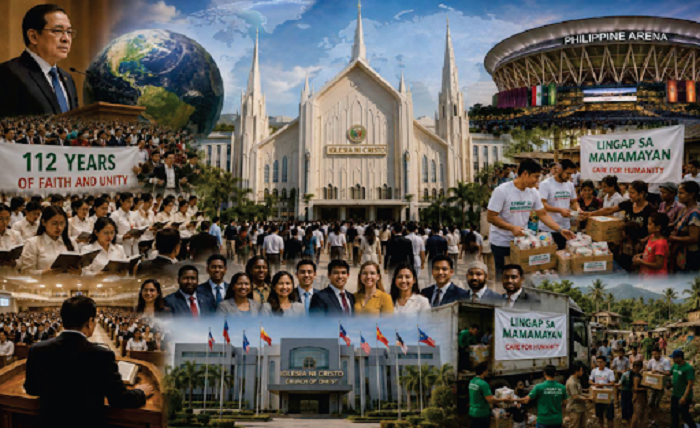
For more than a century, Iglesia Ni Cristo has served as a shining example of how a long-
standing religious institution can remain firmly rooted in doctrine while expanding across
cultures, continents, and generations. Founded in the Philippines in 1914, the Church of Christ
has grown into a global Christian organization with a presence in 169 countries and territories.
This illustrates how faith-based institutions can adapt to a rapidly changing world without
compromising their core beliefs.
Maintaining Doctrinal Consistency in a Diverse World
Like all of its initiatives, Iglesia Ni Cristo’s global development is centred on doctrinal
consistency. Its teachings are based solely on the Bible, emphasizing worship of the one true
God, faith in Jesus Christ as the Son of God, and obedience to biblical commandments. Despite
its presence in diverse cultural landscapes, the Church maintains uniformity in worship practices,
administration, and instruction. This centralized approach preserves theological clarity while
enabling its members from 152 racial and ethnic backgrounds to practice their faith cohesively.
Structured Leadership: Key to Global Governance
Organizational structure is crucial to this continuity. Under the leadership of its Executive
Minister, the Church administers congregations worldwide through ecclesiastical districts. For
their part, administrative centers in the Philippines, the Americas, Europe, and Northeast Asia
coordinate spiritual guidance and operations.
This framework allows the Church to effectively oversee thousands of congregations and
maintain order in the twice-weekly worship services. Separate children’s worship services
further illustrate how structured programming nurtures faith across generations.
The INC’s Strategic International Expansion
The INC has always applied a methodical approach to global expansion, beginning with its first
international outreach in 1968. After initially establishing congregations in Honolulu and San
Francisco, the Church extended its presence to Europe, Australia, Asia, Africa, and Latin
America over the following decades.
By the 21st century, INC worship services were being held across six inhabited continents. But
rather than decentralizing doctrine to accommodate regional variations, the Church exported a
unified system of worship and governance, enabling consistent religious identity worldwide.
Institutionalized Humanitarian Engagement
The Church’s humanitarian engagement is yet another facet of its adaptation. Through the Felix
Y. Manalo Foundation, Iglesia Ni Cristo carries out large-scale social initiatives addressing
poverty, healthcare, disaster response, and community welfare. Programs such as Lingap sa
Mamamayan (Care for Humanity) provide medical assistance, food distribution, and essential
supplies in areas facing hardship.
In 2018, the Church set a Guinness World Record for the largest charity walk, demonstrating
coordinated participation on an international scale. Recognition such as the Banaag Award in
2021 further attests to the organization’s institutional engagement beyond religious boundaries.
Infrastructure as a Modern Symbol of Unity
Infrastructure has always played a key role in reinforcing the Church’s contemporary presence.
With approximately 5,000 houses of worship constructed worldwide, Iglesia Ni Cristo has
established visible centers for community gathering and spiritual life. Landmark projects such as
the Philippine Arena, inaugurated during its centennial celebration in 2014, symbolize
organizational capacity and global unity.
As globalization reshapes societies, long-standing religious institutions face the challenge of
remaining relevant without compromising identity. Iglesia Ni Cristo’s adherence to doctrinal
clarity, structured leadership, humanitarian outreach, and international infrastructure illustrates
how a century-old Church continues to function cohesively within modern global society.